Reversing
kvm

We found a mysterious program that none of our most talented hackers could even begin to figure out.

Author: toshi

Solves: 58
We are given a file
This sets up a vm and a vcpu using KVM apis. An area is mmaped between both machines loaded at 0x0 in guest. Then _payload from the binary is copied to this area and rip is set to 0. This means code for vm begins at 0x202174 and probably ends at 0x20348C
Code at 0x202174 is quite straight forward:
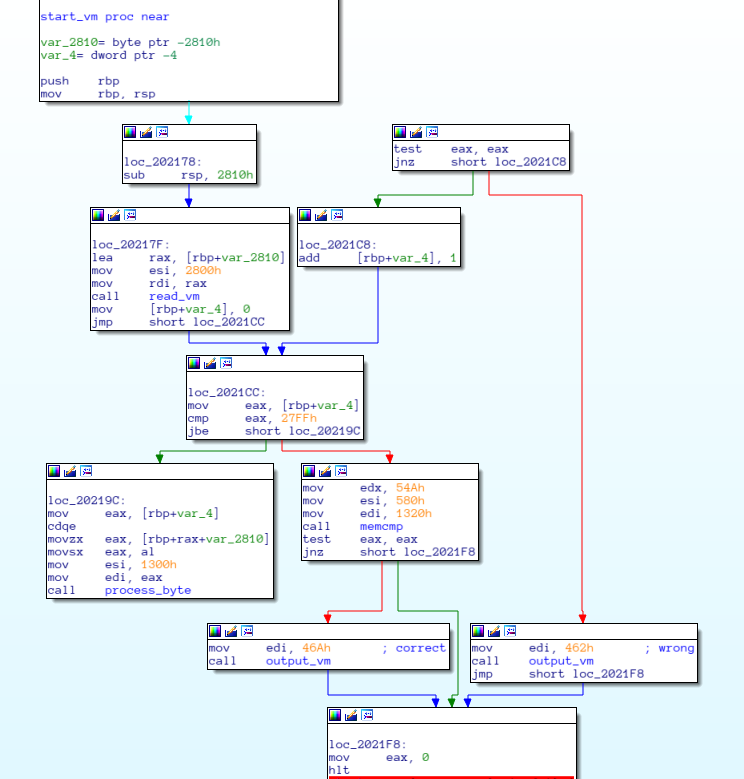
First it reads 0x2800 bytes, then it calls process_byte on every byte. This call should return 1 otherwise it goes to "Wrong" message. Aftet this memcmp is called to match two memory regions at addresses 0x1320 and 0x580 which also decide Correct/Wrong message.
process_byte#
This is where the challenge starts. First basic block comes to an abrupt hlt
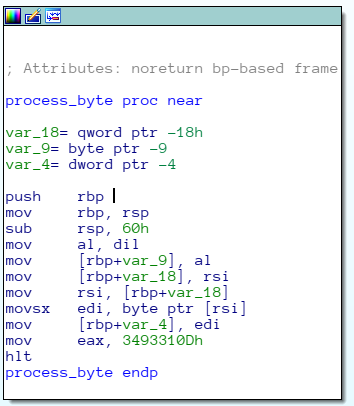
Looking at the function that starts the VM with KVM_RUN, there's a handler to handle IO and check when machine halts;
if ( ioctl(*(_DWORD *)a2, 0x8090AE81uLL, &v7) < 0 )
 {
   perror("KVM_GET_REGS");
   exit(1);
 }
 result = v7.rax;
 if ( !v7.rax )
   return result;
 v4 = jumper_fn(v7.rax);
 v7.rip = v4;
 if ( ioctl(*(_DWORD *)a2, 0x4090AE82uLL, &v7) < 0 )
 {
   perror("KVM_SET_REGS");
   exit(1);
 }

 __int64 __fastcall jumper_fn(int a1)
{
  __int64 *v1; // rdx
  __int64 v2; // rdx
  __int64 result; // rax
  int i; // [rsp+1Ch] [rbp-14h]

  for ( i = 0; ; ++i )
  {
    if ( i >= dword_202170 )
    {
      fwrite("Error - bug the organizer\n", 1uLL, 0x1AuLL, stderr);
      exit(1);
    }
    if ( LODWORD(qword_2020A0[2 * i]) == a1 )
      break;
  }
  v1 = &qword_2020A0[2 * i];
  result = *v1;
  v2 = v1[1];
  return (unsigned int)result;
}
Based on what rax\eax contains rip is updated to new value in the vm according to
   {
    0xC50B6060: 0x454
    0x9D1FE433: 0x3ED
    0x54A15B03: 0x376
    0x8F6E2804: 0x422
    0x8AEEF509: 0x389
    0x3493310D: 0x32C
    0x59C33D0F: 0x3E1
    0x968630D0: 0x400
    0xEF5BDD13: 0x435
    0x64D8A529: 0x3B8
    0x5F291A64: 0x441
    0x05DE72DD: 0x347
    0xFC2FF49F: 0x3CE
    }
This opens up a lot of code to analyze with similar mov eax, const; hlt pattern.
I use a little r2 and dot to generate this file to look at the code easily.
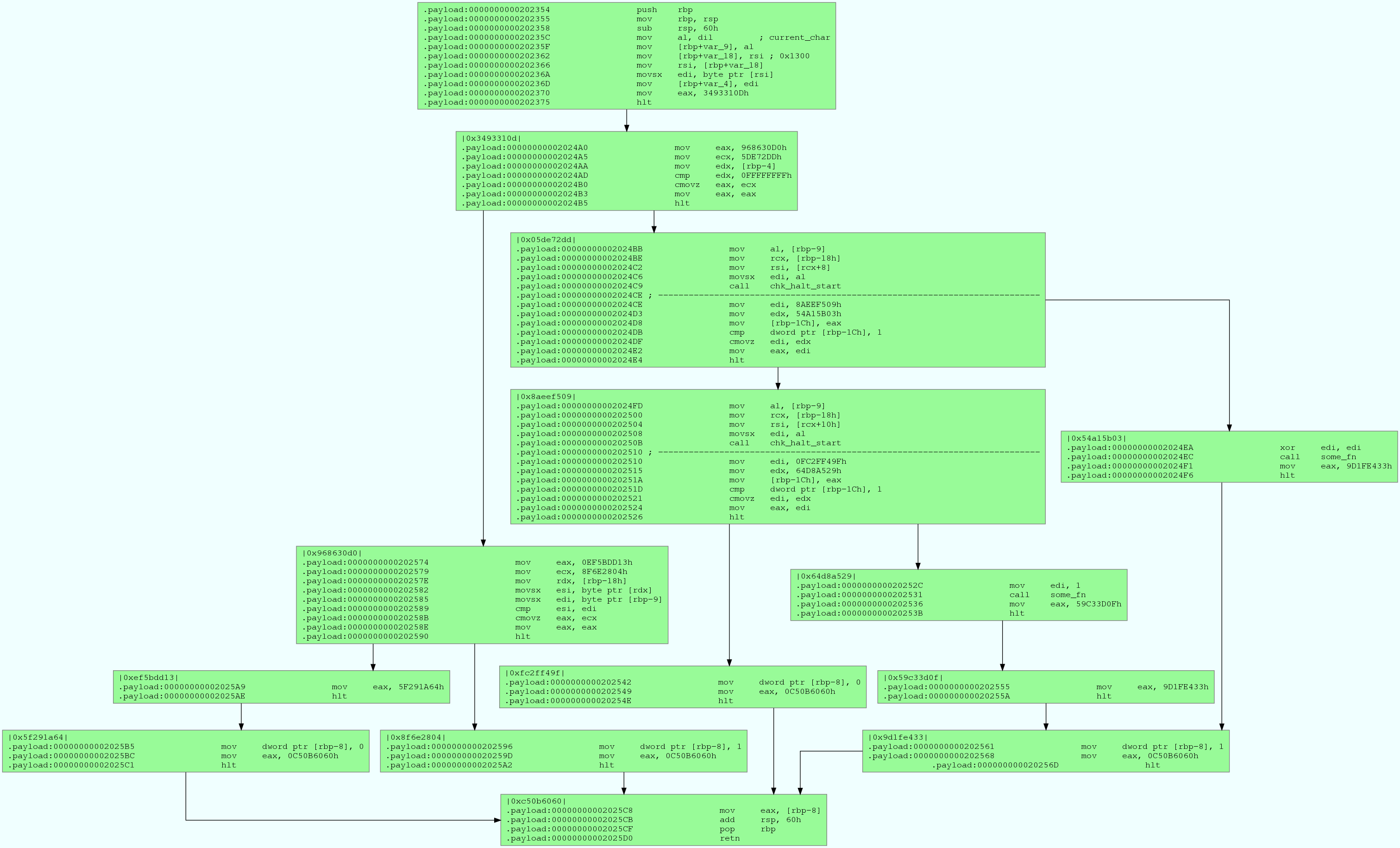
Now we can ignore hlt and consider this as one function with the following pseudocode
def process_byte(byte, idx):
    c = some_arr[idx]
    if c == 0xff:
        t = process_byte(byte, idx+8)
        if t == 1:
            write_bit(0)
            return 1
        else:
            t = process_byte(byte, idx+0x10)
            if t == 1:
                write_bit(1)
                return 1
    else:
        if byte == c:
            return 1
        else:
            return 0
This is basically like a dfs search for the byte provided. Based on where the byte is found in the tree write_bit is called with 1\0 which writes the bit to 0x1320.
0x1320 is used in memcmp to determine the correct/wrong.
The tree root is at address 0x203474 which is (0x1300+0x202174) as process_byte is always called from start_vm as process_byte(byte, 0x1300)
The problem now is given some data and the ability to write 1/0 to other region, we make them match.
The tree looks like this:
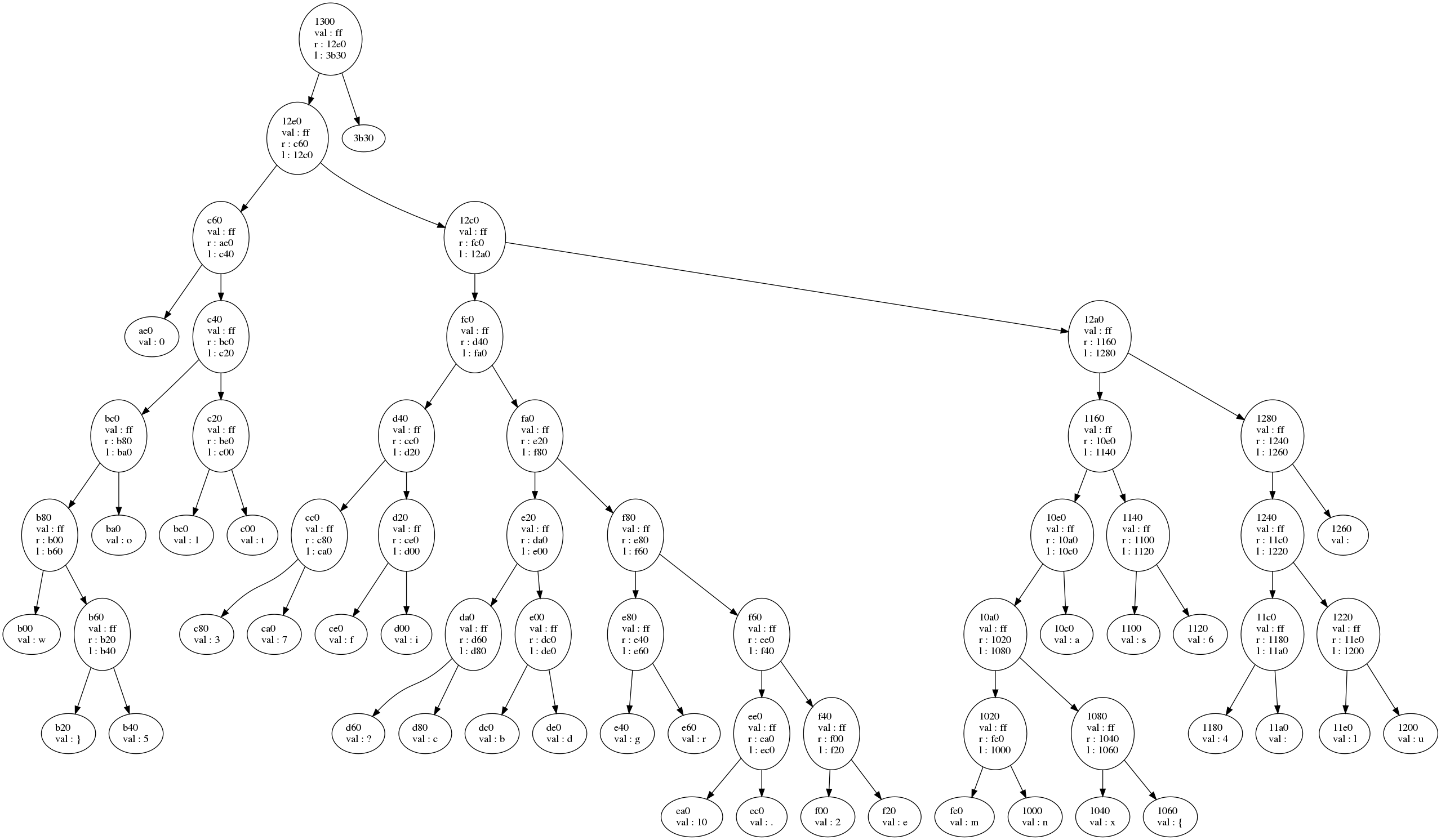
Based on whether a right/left is taken to traverse to the leaf node a 1/0 is written respectively. This way we can write to
Now we have some bitstrings for each leaf node and the final bit string to be written, we need to find the right order that will fit in 0x2800 bytes.
  {
  '0001110': '4'
  '11111010': 'e'
  '110110': '6'
  '0001010': '?'
  '00111010': '\n'
  '1011010': 'r'
  '10100': 'o'
  '000010': '3'
  '01100': '1'
  '1101010': 'd'
  '1101110': 'u'
  '1': '\x00'
  '100010': '7'
  '1100100': '5'
  '110010': 'i'
  '010010': 'f'
  '10000110': 'n'
  '0011010': 'g'
  '010110': 's'
  '11000110': '{'
  '000': '0'
  '00000110': 'm'
  '01111010': '2'
  '10111010': '.'
  '01000110': 'x'
  '0100100': '}'
  '0101110': 'l'
  '11100': 't'
  '100110': 'a'
  '0101010': 'b'
  '000100': 'w'
  '1001110': 'h'
  '1001010': 'c'
  '11110': ' '
  }
This is similar to word break problem and can be solved recursively/dp.
Dump the reference memory region 0x580 of length 0x54a and solve.
dump = open("dump", "rb").read()
s = "".join(map(lambda x:format(x, '08b')[::-1], map(ord, list(dump))))

def solve(str, n, result):
    for i in xrange(1,n+1):
        substr = str[:i]
        if substr in smi:
            if i == n:
                result += substr
                print result
                break
            solve(str[i:], n-i, result+substr+" ")

solve(s, len(s), "")
The string that was generated was a TAR archive with the flag. Full script